

On Consciousness
The word “consciousness” has been abused so much that anyone who watches a 20-minute Sadhguru or Deepak Chopra video will think they are now experts on the supposedly “mystical” field of spooky “consciousness” that even “science” knows so little about — and thus the scriptures (and their books) will come to the rescue by uncovering its mysteries through — wait for it — speculation!
Speculation is part of the scientific process too, but to assume speculation alone will solve the consciousness problem — without a single drop of empiricism, experimentation or data — is a mistake. And what do you mean by “even science cannot understand it”? Is science a person who is confused about something? No — science is just a tool. Saying that is like saying “even the hammer cannot nail properly, it bashed my finger instead.” The problem is not in the hammer — it’s the clumsiness of the hand using it. Likewise, the problem is not in science when there are gaps in human knowledge — it’s in the human biases and assumptions that form the real limitations of the method. Science is just a tool, but the best one we have so far to uncover facts about reality. And it’s not a weakness that scientific facts keep updating; updating is what a healthy method does, and refusing to update is the actual failure.
By now you’ve figured out that I’m not a big fan of how Sadhguru and Deepak Chopra talk about this subject. They are intelligent, charismatic, charming figures who speak about supposedly “eastern” and “mystical” things that no one quite understands — and on close inspection, neither do they. If someone genuinely understands what they’re talking about, there’s no need to talk in circles and riddles and poetry, and no need to bolt jargon like “quantum” or “engineering” onto a claim to make it sound credible. There’s only one way to become credible: by being intellectually honest and not speaking with authority about something you haven’t understood.
Here’s the simplest test for the difference between them and me. Ask: what observation would prove you wrong? I can answer instantly — show me one verified brain-dead person with awareness and my whole argument collapses. A claim like “quantum consciousness” names no such observation; nothing could ever falsify it, which is exactly why it isn’t science. That is the line that separates a real claim from something that merely sounds deep.
If the question is “how heavy is this watermelon?” the answer should be “it’s X kg” — not “if we reflect on its quantum superfluence, then it is X as well as Y kg.” You have the right to say that, but good luck making sense to anyone. What I’m pointing to is First Principles, or Foundational Reasoning: the basics can be explained in simple terms to establish the premise behind a body of knowledge. If the initial premise is wrong, any argument built on it isn’t worth examining. This is where I part ways with the gurus — their very foundations are shaky. They argue from an erroneous premise, so nothing esoteric they say ever makes sense unless it’s ordinary life advice an old village grandmother might give you from experience. That’s why they’re rarely straightforward and lean on riddles and jargon. Should you listen to them? Your choice. But should they be trusted when they challenge a scientific principle? Perhaps not, because clarity and precision are vital to the scientific method.
A beard, the title of “guru” or even a medical degree doesn’t make us experts on every “sciency” subject — in that sense, even I am not an expert on consciousness. For actual science, go speak to a neuroscientist or read (and properly understand) their work. What I’m doing here is reiterating some ground-level facts that are well-established in neuroscience, in plain language. I’ll work through the most talked-about pieces: limitations of science, consciousness, perception, identity, death and afterlife. This still won’t be science itself — it’s communication of science to the public; for the real thing you’d read peer-reviewed papers. Doing science is hard; dismissing it is easy — you just reach for the psychological defense called denial to justify the reasoning errors known as biases.
Limitations of science
Science cannot figure out everything. Everybody knows this, but do they understand what they think they know? First — there is no western nor eastern science. There is just science, either outdated or updated. Updated science with the latest information is what moves the field forward; without updates, knowledge gets stagnant. Ayurveda, for instance, was an actual science during the Maurya Empire, but no one ever updated it (its practitioners still believe three humors cause disease, even in a post-germ-theory era), which is what makes it outdated. Other examples: bloodletting, leech therapy, astrology, alchemy — all once thought scientific until newer evidence came along.
What is science? Merely a tool, like a hammer — one we use to observe and document our surroundings. It’s not even a body of knowledge, as is often assumed. Bodies of knowledge are built on scientific data, and our observation of that data can be — and has been — wrong, whether from a lack of technology at the time or plain human clumsiness. When better technology arrives, old data is reinterpreted and the body of knowledge is rebuilt. That’s how science self-corrects. Like it or not, it is until now the best way of acquiring information about anything. If you think you’ve found something better for uncovering the truth about the universe, then show us how it works — you’d be doing humanity a huge favor. But note the word: “show,” don’t just tell.
Consciousness
Honestly, we don’t know how to describe it in one word or quantify it objectively, but we do know for a fact that what we call consciousness arises from the brain. Unlike René Descartes’ dualism, widely accepted until about 70 years ago, we now understand that without the brain there is no conscious experience in animals (including humans) — the correlation is that powerful. Every time we run experiments to see if conscious experience exists outside the brain, we fail, because the brain seems to be the limit. But before anyone pats themselves on the shoulder for “defeating science,” we do know quite a lot about consciousness. People assume scientists tackle it with just high-school physics, chemistry and biology and forget that a vast field called neuroscience exists — using those same simple principles. And why not? It works.
Consciousness is not a single entity; it is borne out of a process inside the brain, and for us to be consciously aware all those processes have to work together. Take the analogy of vision. Light (photons) strikes the retina and evokes electrical signals in the nerves leading into the brain. The processing neurons (mostly at the back, in the occipital cortex) interpret that information as vision. So in crude terms, vision is a construction — the brain turning certain wavelengths of light into “something significant.” Out there are just photons reflecting off surfaces; we build them into colorful information — a construction, but a practically important one, because it helps us navigate physical space.
Consciousness works the same way, only it draws on a far wider interplay of processes (external stimuli, the reticular activating area, the cerebral cortex, sensory nerve tracts, vast groups of nerve cells, neurotransmitters, synapses and so on). We feel aware and sentient but can’t quantify exactly how much. We can, however, determine the basic fact of whether we are conscious at all. Kill the brain completely (as in brain death) and the person is neither aware nor conscious. But observation can mislead, so let’s use technology. EEG maps brain waves; we see patterned waves during wakefulness and even during sleep — which, contrary to popular belief, is not unconsciousness but low awareness. When blood supply stops (a massive stroke) and the brain dies — even if heart and lungs run on machines — those waves vanish. fMRI and PET scans, tracking blood flow and metabolic activity, tell the same story. Whatever the method, the result is firm: when the brain dies, activity inside it disappears, and with it our consciousness.
That is enough to establish that consciousness cannot exist outside the human brain. If you think it can, show me a completely brain-dead person who is at least minimally aware. This makes the classic Cartesian dualist argument — a mind that floats free of the body — void. It doesn’t by itself answer every deep question about why experience feels the way it does, but it does kill the version the gurus actually trade on, where the self detaches from the brain and drifts off somewhere. That claim is testable, and it fails.
Perception
How do we perceive something? In the simplest terms, perception is a processing unit interpreting physical information after a receiving unit takes it in. Back to vision: the brain receives light through the retina and optic nerves and tags it by building the experience of color. Colors do not exist in the physical world outside a nervous system — they’re the brain’s way of sorting raw electrical data into something orderly so it can guide behavior. The same goes for sound: vibrations occur in the physical world, but “sound” is the brain’s ordering of those vibrations. Our perception of the world is broadly a collection of such constructions that feel like one seamless thing.
To understand perception simply, forget the famous “five senses” — there are far more, and even within those five organs different receptors relay different information to different brain areas. Beyond the five we have proprioception (position sense in the joints), sensors in tendons and muscles, sensors in other organs, and a vast assortment of skin receptors for distinct sensations (so “skin senses touch” is a severe understatement). Lose pain sensation in the feet (as in untreated diabetics) and you may injure them unnoticed — letting wounds get infected — because you’re not aware enough to protect them. Lose one sense and others fill the gap (the blind navigate by touch and hearing), but a constant relay of sensations to the brain, even during sleep, is what keeps us aware of our surroundings and ourselves.
By now you may be likening the brain to a computer — inputs, a processor, an output. Not quite. In a computer, cut the channel from processor to monitor and the observer can’t read the output, even though processing continues. The brain is different: it acts as both the processor and the observer — imagine a self-aware computer chip and you’re close. Even that undersells it, since the brain isn’t one processor but a collection of 86 billion-plus of them. And it has earned the right to be hard to study: of the roughly 20,000 genes in our body, about 14,000 are expressed in the central nervous system — around 70% go into building the brain and spinal cord, the most complex organs in the biosphere. How, then, can anyone versed in neuroscience believe the mind is not inside the brain?
So conscious awareness is borne out of a process occurring nowhere but inside the brain. Why doesn’t Descartes’ dualism hold today? Because the dependence can be demonstrated, repeatedly, by anyone who understands the scientific process. This is why I keep repeating it: you are what your brain makes you, and your brain is nothing but the generator of your ‘self.’
Identity
“You are what your brain makes you, and your brain is nothing but the generator of your ‘self.’”
Identity is dear to us all. Each of us has either an assigned identity or a conditioned one. Identities can be assigned by others outside our choice (our names, or tribal membership like nationality at birth) or taken up by ourselves later as we develop our own choices (changing a birth name, caste or nationality). Conditioned identity is one you assume because it’s always been there since birth — a rigid sense of self tied to religion or nationality. Setting aside identity assigned by others, what determines the rest? What makes us who we are?
Most people know the nature-versus-nurture debate. To understand identity in the broadest sense, replace the “versus” with “and” — it is nature and nurture, because the two aren’t mutually exclusive. By nature I mean what’s largely outside human control — our genetic makeup, how the nervous system develops in the womb, diseases or injuries around birth or later. By nurture I mean the influence of society — the community we’re born into, our parents, our friends, our relationships. As we grow, the brain processes all this while still developing, and it processes it differently for everyone, because every brain is similar yet very different. These intricate interplays — plus the brain’s constant revising of memory and behavior — settle into a sense of identity, especially as the brain stops developing as rapidly after about 26 to 30, when a more rigid sense of self sets in.
Picture a clone of yourself, born from a borrowed womb, raised in the exact conditions of your childhood. Will he become you? Theoretically, if you mimicked every condition down to the femtosecond and matched his biology to yours at all times, perhaps yes. In reality, always no — there’s too much you can never control, and no two sequences of events play out identically. Identical twins make the same point: genetically a clone of each other, yet over a lifetime they grow distinct tastes, identities and choices. So nature and nurture, with a touch of randomness, produce our unique sense of self.
If you want the brain’s role shown even more directly, look at what happens when the brain itself is altered. Sever the corpus callosum linking the two hemispheres — the “split-brain” operation — and you can elicit two partly independent streams of awareness in one skull: the unity of the self fractures when the brain is divided. Damage the prefrontal cortex, as the railway worker Phineas Gage famously did, and the personality changes with it. Injure or remove tissue and the person changes accordingly. The self tracks the brain, not the other way around — so even your identity and personality aren’t outside it.
Death and afterlife
What happens when you die? That depends on how you define death. Philosophically, you die when you cease to exist in the world you and others know. Scientifically, death is the point when your organic body ceases to function, including — and especially — the brain. This is why brain death (the brain dead while the body lives on) matters so much socially and legally. The brain is the source of your awareness and your identity; when it stops irreversibly, you cease to exist.
People may argue that the “idea” of the person whose brain just died lingers on. True, to a point — but to untrained eyes it seems the subjective part of them still lives, what many call the ‘soul.’ That “idea” persists because other brains are perceiving and storing memories of the person’s characteristics. This explains why the “soul,” the mind transcending the body, is so ubiquitous across cultures separated by time and space: the soul may actually be information about a person stored in other people’s brains. And no two people hold the same idea of someone — my perception of Sadhguru will differ from those closer to him.
Because people believed the mind transcended the body, the concept of an afterlife probably arose — without modern science, it was the commonsense view that people must exist outside their bodies. Today the afterlife holds no ground in serious scientific study of any kind. We can examine the psychology of why people believe in it (reincarnation, heaven and hell), but the idea that the afterlife as described in scripture is literally real runs into a basic problem: it’s untestable, resting on speculation and premises that can’t be demonstrated. When we know with strong confidence that the brain is the seat of our awareness, identity and personality, it makes little sense to assume those facets live on outside the dead person’s brain (except as memories in other brains). Old ideas of ghosts and spirits were early attempts to make sense of reality given the limits of the time. But today, reaching for a supernatural explanation to confirm a belief in the afterlife means turning away from the evidence. Maybe it gives comfort, maybe it’s a way to cope after losing a loved one — that is human and understandable — but the evidence simply doesn’t support it. You live on after death only as information stored in other people’s brains. Does all that add up to exactly you? Perhaps not.
Wrapping it up
So there’s little doubt the brain is the seat of our conscious awareness, personalities, memories, choices, actions, preferences and sentience. Is a bacterium sentient? Perhaps not. Are we? Yes, and our brains are evidently responsible for that.
Now, some people hear “it’s all the brain” and assume science is calling their inner life fake — and that is exactly the fear the gurus prey on. So let me be clear about what I am not saying. I am not saying your experience is an illusion, or that you’re “just chemicals.” Your inner life is completely real — imagination, love, grief, music, the taste of your morning tea are all real. I’m saying they are produced by the brain and don’t float free of it. Think of how the stomach produces digestion: digestion is real, but it isn’t a separate substance hovering above the gut — it’s what the gut does. Consciousness is what the brain does: a genuine, first-person experience that is, at the same time, entirely a biological process — no second, ghostly substance required.
This is also why “the brain is just a computer” undersells it. You can run the same program on very different machines, and in the same way a feeling like pain isn’t identical to one exact pattern of cells — an octopus, or one day perhaps a machine, could feel something while built completely differently. Mental life is fully physical, yet it can’t be flattened into a single tidy description of wiring: real, physical, and not reducible to one neat formula, all at once. (The textbook names for these positions are biological naturalism and non-reductive physicalism, but the plain idea matters more than the labels.) The mystics need you to believe science empties your inner life of meaning so they can sell the meaning back to you. It doesn’t, and you don’t need to buy it back.
We need the brain to experience and share subjective sensations with others who have similar brains. We communicate that through language, and this is a prime fact separating us from other primates and mammals: we use language to share what our individual brains generate. A dog is sentient and self-aware too, but its range is limited next to ours, because our brains evolved a far richer capacity to generate and interpret language — letting us pass thoughts, even abstract ones, across ages and boundaries to build civilizations. The language-generating brain is what makes us human.
Accepting the material nature of self-awareness is hard partly because we have no other language-speaking sentient life form to compare ourselves to. Until we find an alien species like us, or build an AI that convinces us it is self-aware, some may not accept the brain theory of consciousness at all — and until then, we may not fully grasp Thomas Nagel’s question, “what is it like to be a bat?” That is genuinely open and worthwhile. But how can we approach it rationally if we won’t accept the basic premise that the brain is the seat of all subjective experience? What science doesn’t fully understand yet is where and how exactly these phenomena arise — but there’s little doubt it’s somewhere within the brain. This may seem counter-intuitive, even reductive, but that’s where the evidence points, and we have to accept facts for what they are, not for how comfortable we’d like them to be. Until someone can demonstrate — not just assert — that the mind is independent of the brain, that claim isn’t worth serious consideration.
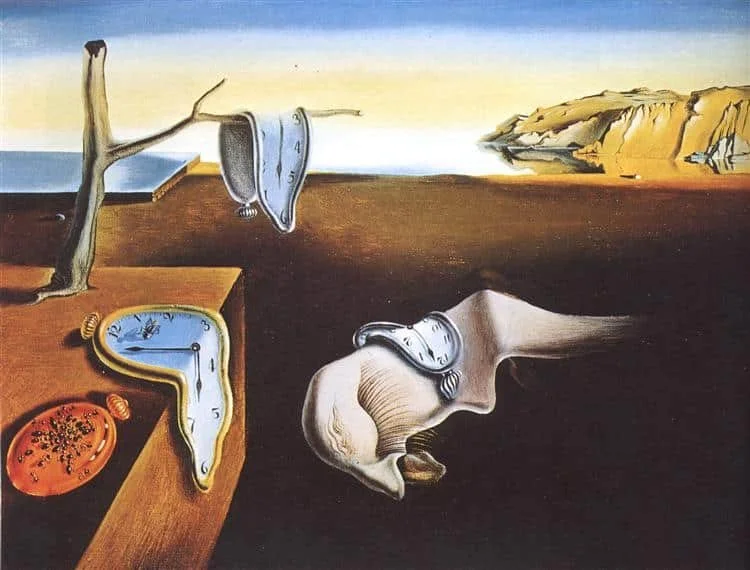
Salvador Dali’s “Persistence of memory”
A surrealist painting symbolizing the fluidity of time, elasticity of human memory and the fragility of reality
