

Buddha was not Nepali
A couple of days ago, my wife and I were watching the Indian comedian Samay Raina’s popular and lighthearted parody talent show India’s Got Latent. While making fun of one very obnoxious participant, Raina went on to say, “Did you know that Buddha was from Bihar as well?” My wife said to me, “This is gonna make some Nepali people lose their minds.” It happened exactly as she predicted. Within hours, popular Nepali social media pages were amplifying the line with dubiously worded infographics — “controversial statement,” “Raina mentioned Buddha was born in India,” “Raina facing backlash.” In a world of dopamine-hungry algorithms this blew up and became a meme across the Nepali-speaking internet, and the comment sections filled up with jingoistic displays of temporary ultra-patriotic fervor.

Example Instagram post probably aggravating the situation
This is something I call a non-issue. It has no objective pragmatic value and is a form of vanity. If Samay Raina says something inaccurate, why should we have to express outrage? We have more important things to talk about. And yes, I am aware of the irony of spending a few thousand words on something I have just called unimportant, and I will own it. What a society gets loudly wrong is usually more revealing than what it gets quietly right, and this particular error is very revealing. My problem is not with Raina. It is with a story about Siddhartha Gautama’s birthplace that most of us have never actually bothered to check.
Let me concede the obvious first. Lumbini lies inside the borders of present-day Nepal. “Buddha was born in Nepal” is therefore true on a map, and Raina’s Bihar line is the inaccurate one. But that is not the claim people are making when they type it in capital letters under a comedian’s clip. What they mean is that the Buddha was Nepali — that he belongs to us, that his prestige is national property. That claim is an anachronism by roughly two thousand years, and it is the one worth taking apart.
Start with the date, because we cannot even agree on the century. Traditional Theravada chronology places Siddhartha Gautam’s birth around 623 BCE. The date most of us were taught in school, 563 BCE, is not ancient at all — it is a nineteenth-century correction produced by European Indologists. And since the Göttingen symposium convened by the Indologist Heinz Bechert in the late 1980s, the scholarly consensus has shifted the entire life forward by more than a century, placing his death at around 400 BCE and therefore his birth at around 480 BCE. We are arguing about the nationality of a man whose century of birth is still an open question.
At the time of his birth, Lumbini was a much sought-after pleasure garden in the territory of the Shakyas, whose seat was Kapilavastu. The Shakya polity was a gana-sangha — an oligarchic assembly of clan heads with rotating leadership — not a republic in the sense of pre-Caesar Rome or the present-day United States, and certainly nothing resembling a nation-state. Even then the site was shared, and on some accounts contested, between the Shakya and Koliya clans.
After his birth came a long sequence of owners. Buddhist tradition holds that Vidudabha of Kosala destroyed the Shakyas, though the historicity of that episode is disputed; the annexation of Kosala by Magadha under Ajatashatru in the mid-fifth century BCE stands on firmer ground. Magadha itself passed from the Haryanka dynasty to the Shaishunaga, then to the Nandas, and then to the Mauryas. After the Mauryas came the Shungas, then the Kushans, then the Guptas.
One of those owners deserves elaboration. The Maurya emperor Ashoka turned to Buddhism around 260 BCE after invading Kalinga, and around 249 BCE he raised an inscribed pillar at Lumbini declaring hida budhe jāte — “here the Buddha was born” — and cut the village’s taxes to mark the occasion. That pillar is the single strongest piece of evidence Nepal has that Lumbini is the birthplace at all. It was placed there by an emperor ruling from Pataliputra, in what is now Bihar. The Chinese pilgrim-monks Faxian and Xuanzang both visited and described the site afterwards, in the early fifth and the mid-seventh centuries CE. Lumbini was never lost in the sense of being unknown. It was marked, inscribed, tax-exempted and visited for well over a thousand years.
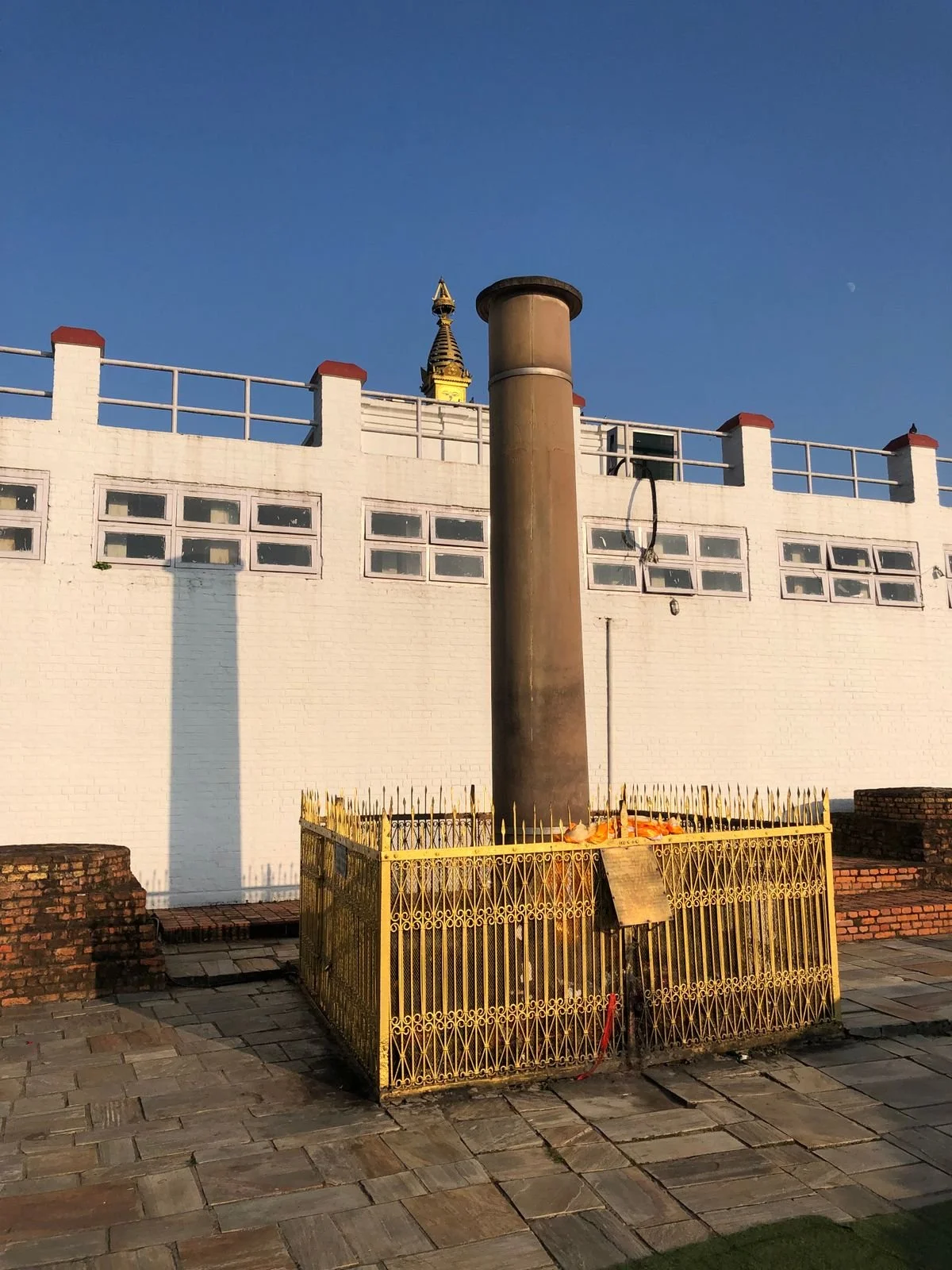
Ashoka pillar from Lumbini, present day Nepal
What did eventually happen is that Buddhism declined in the region, pilgrimage traffic dried up, and the site was reclaimed by the malarial subtropical jungle of the Gangetic plain. The causes are not well documented; the factors usually proposed are shifting settlement patterns, disease, and the collapse of monastic patronage. There is one striking medieval trace: an inscription cut into the Ashokan pillar in 1312 CE by Ripu Malla of the Khasa Malla kingdom of Sinja and Jumla in the far west — a completely different entity from the Mallas of the Kathmandu Valley, whom Nepali readers usually picture first. But that inscription is evidence of a pilgrim passing through, not of administration or rule. Nobody was governing Lumbini in any meaningful sense.
The site re-entered the public record in 1896, during the rule of Bir Shamsher Rana. The version most Nepalis have heard credits the German archeologist Alois Anton Führer with meticulously tracing the site using ancient Chinese travel logs. The record suggests close to the opposite. Khadga Shamsher Rana, the governor of Palpa, located the pillar in December 1896; Führer arrived afterwards and took the credit (Führer was a fraud and was eventually kicked out of the Archaeological Survey of India in 1898).
And the national attachment to the Buddha’s birthplace is much younger than 1896 anyway. The Lumbini we are all so protective of is a twentieth-century state project. U Thant, the Burmese Buddhist Secretary-General of the United Nations, visited in 1967 and was appalled by its neglect. In response, the Lumbini Development Trust followed in 1970, and the Japanese architect Kenzo Tange produced the master plan in the years after. “Buddha was born in Nepal” as a piece of state-sponsored branding — on tourism campaigns, on airline liveries, in ministerial speeches — belongs mostly to the last twenty years. The thing people are defending so fiercely is younger than their parents.
Nor have we settled where Kapilavastu was. Indian archeologists identify it with Piprahwa in Uttar Pradesh; Nepali archeologists identify it with Tilaurakot in Kapilvastu district. Both sides have suggesting evidence, both sides have national pride riding on the outcome, and that is a large part of why the question stays open. Same pattern, same century, same nationalism — only better funded.
This retrofitting of sacred figures onto convenient geography is not a Nepali habit; it is a human one. For example, the Gospels of Matthew and Luke both place Jesus’s birth in Bethlehem, but the two cannot be reconciled — Matthew has him born before King Herod’s death in 4 BCE, while Luke ties the birth to the Roman census of Quirinius in 6 CE, a full decade later. Mark and John, the earliest and the latest of the four, contain no birth narrative at all and simply call him a Nazarene. Most critical historians read Bethlehem as a later theological addition designed to satisfy Old Testament messianic prophecy. Even the “1 CE” we all carry around is an error, traceable to the monk Dionysius Exiguus miscalculating the Christian era in 525 CE.
So, what should we make of “Buddha was born in Nepal”? Not that it is false. I have already conceded that it is true on a map. The problem is that Nepal as a political entity dates from the Gorkha conquests of the 1760s, and the present border with India was fixed by the Treaty of Sugauli in 1816. Borders are not retroactive. You cannot run a modern boundary backwards through two and a half thousand years and claim whoever happens to fall inside it.
The easy response is that nations are arbitrary fictions and that therefore none of these matter. Until recently I used to hold this opinion myself. I have now learned that this is too quick of an assumption, and it backfires — if borders mean nothing, then Raina’s “Bihar” is no worse than our “Nepal.” The political scientist Benedict Anderson considered nations as imagined communities, not fabricated ones, and he was careful about the difference. Nations are imagined into being and then they are entirely real: they collect taxes, issue passports, and send people to war. Nepali identity is a genuine thing that was assembled at a particular time for particular reasons. It is worth taking seriously as a political fact. It is not worth taking seriously as an eternal one, and it is certainly not worth projecting backwards onto a man who died two millennia before the word existed.
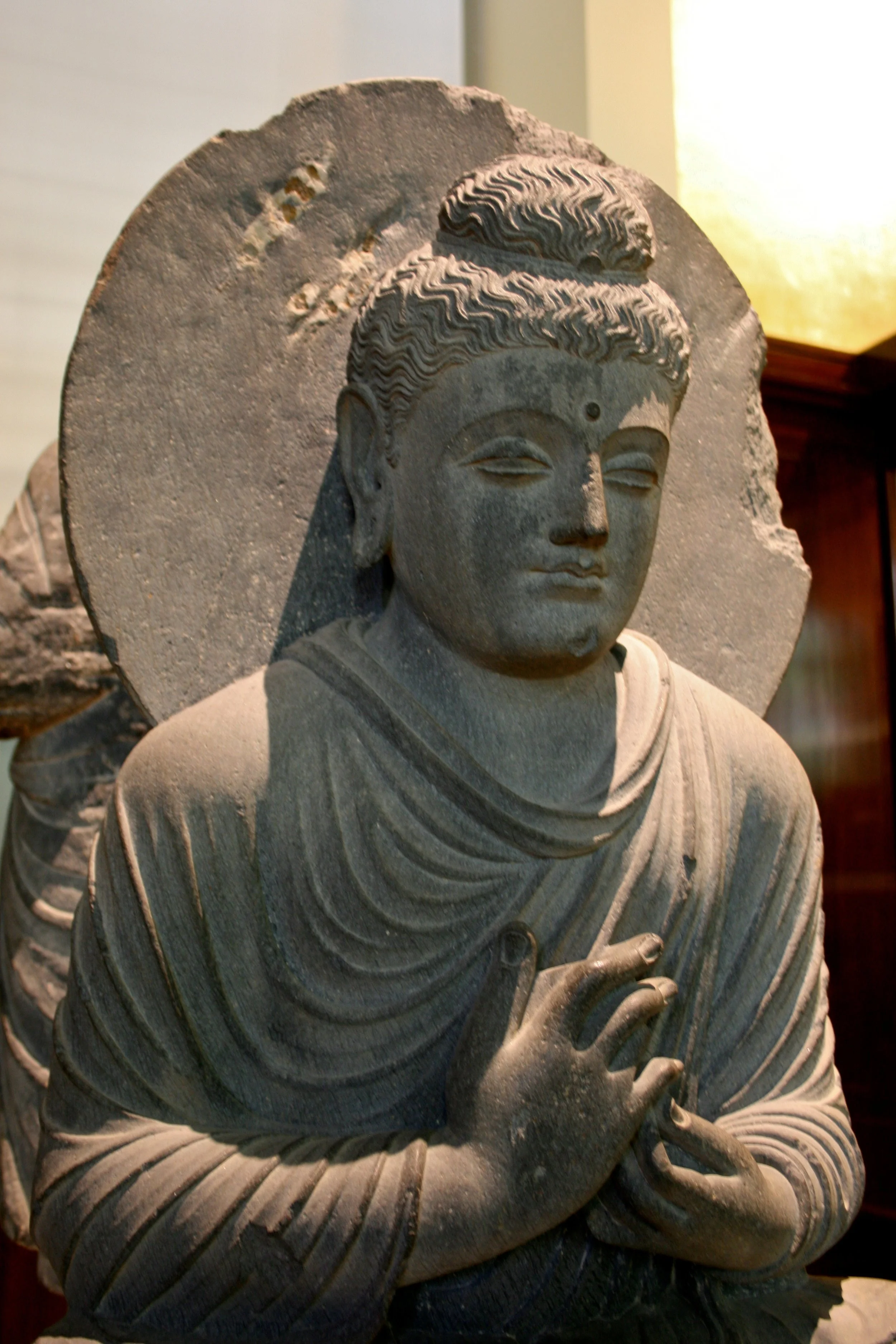
Seated Buddha of Gandhara, thought to be the oldest free-standing statue of the Buddha, excavated from Gandhara, present day Pakistan. The statue dates back to the Kushan empire (2nd to 3rd century CE) and currently is in The British Museum.
What modern critical history keeps showing is a gap between what tradition asserts and what the evidence supports. Clinging to literal birth stories, mythologized origins and the divine perfection of ancient teachers ties our understanding to political timelines that were manipulated long before we were born. The better move is to decouple historical myth from philosophical wisdom. Let go of deifying the messenger and you can discard the distortions while keeping what is useful — the Buddha’s account of suffering and its dismantling, Jesus’s insistence on empathy and the protection of the marginalized.
So, on this Samay Raina business: the Buddha would tell you to let go, and he would be right. Clinging to a birthplace is attachment, and attachment, according to him, is where dukkha (suffering) comes from. If the history genuinely matters to you, the energy behind the outrage is better spent elsewhere. Tilaurakot, thought to be where Siddhartha spent the years before he left home, remains under-excavated and underfunded. The Lumbini master plan is decades behind schedule. The site could use people who care about it on an ordinary Tuesday, and not only when an Indian comedian makes a joke. If we want the tourism and the pilgrimage to mean anything over the long term, our priorities are what need to grow up.
