

The lost atheistic schools in Indian philosophy
I remember that every fall, when I went to meet relatives for Tika during Dashain, I was asked why I held atheistic views—often in a loaded and condescending tone—as most considered me merely a contrarian of norms. After I entered medical school, I gradually started to become disillusioned with the metaphysics of religion and the spiritual schools of thought that were dominant where I grew up. I think a major epiphany came during a trip to my ancestral village in eastern Nepal, in the town of Haleshi Mahadev, where people were worshipping stalagmites and stalactites as “shiva linga” and “cow udders,” respectively, in the Haleshi cave. Because I had some grasp of how these mineral formations arise from sediments deposited by dripping water in limestone caves, I saw through what many there did not—that these were simply apathetic limestone formations. Haleshi gufa was a limestone cave, after all. Enough people believed in these mineral formations and considered them sacred, and that belief stuck across generations, turning the place into a major pilgrimage site in eastern Nepal. The entire town’s economy depended on enough people believing that certain limestone formations were deities. It was at that point that I realized questioning was important, and that uncritical beliefs seemed unreliable. I come from a family shaped by both Bhakti and Vedanti spiritualist traditions—prabachans, spiritual and metaphysical lectures, gurus, swami jis, and other godmen and godwomen were revered and worshipped, often blindly and uncritically. Sometimes, this happened in very unhealthy ways as well. I started questioning all of this and asked: who gave these people authority, and why should they gatekeep spiritual knowledge? Why should I believe them?

A Stalagmite worshipped as “shiva linga” in Haleshi Cave in Khotang district, Nepal
When asked whether I knew that God or supernatural entities existed, I would have to say, “I do not know,” because I really did not, and still do not know. This would make me agnostic, as I cannot know something that is unfalsifiable. When asked if I believed in these concepts, I could only be very honest by saying, “How can I believe in something I do not know exists?” This would make me an atheist about that thing, I guess? Spiritual people assert that faith—uncritical belief—is the answer, but I question that circular reasoning as well. Where would that ever practically lead me? These days, I think the “god” questions are not that important. I think ethics, context, and pragmatism matter more in philosophy, so I guess that makes me apatheistic, or indifferent?
I was never taught any alternative views about the universe, but was instead fed immensely contradictory dogma based on confusing premises and axioms, without epistemological, historical, or social context. No one explained where and how their knowledge came from. No textbook or prabachan did it justice, as most were repetitive and encouraged rote learning. My perspectives changed and evolved only after I got access to good internet and met other freethinkers who challenged my own thoughts and helped me improve them. I was privileged enough to have the leisure to explore and enjoy history, science, linguistics, anthropology, and philosophy. Eventually, after I started questioning the status quo and exploring different ideas, I learned to look at things for what they are and not what I wanted them to be. I was curious, but gradually—and after a series of errors, arguments, and maybe bad and embarrassing ideas—I learned to guide my curiosity with reasoning and questioning. Then one day, I discovered that there had been atheistic and agnostic schools of thought in the Indian subcontinent all along, and that this was not just a place full of mystics, but also of reason and logic. I was pleasantly surprised and started learning more.
Most people have no clue what they are talking about when they say “sanatan dharma” (a purist synonym for Hinduism). First, “dharma” does not translate to “religion,” but rather to “duty” or “responsibility.” It goes back to the Vedic tradition of passing down Vedic ritualistic knowledge orally across generations of Brahmins (Sanatan). For instance, Brahmins who were able to recite two Vedas got the title “Dui (two) vedi” and later became Dvivedis, while those who could recite all four were “Chatur (four) vedi” and later became Chaturvedis. These days, they are simply glorified surnames. But I would like to stress that not all Indian philosophy is Sanatana dharma or Hinduism.
Vedic traditions were not accessible to the common public and only came through Brahmins, who claimed to have an inherited and divine authority on the matter. For instance, according to scriptures such as the Manu Smriti, a Vaisya (merchant class) or a Sudra (untouchable) could not become a “Chaturvedi” even if they read all four Vedas. It had to be a Brahmin man, and the Manu Smriti provides extremely rigorous and painful rules and traditions for becoming a Brahmin—it starts with inheritance and birth. Thus, around the 7th or 6th century BCE, some atheistic schools of thought emerged in the Indian subcontinent. This era was marked by the advent of the Sramana (or Samana) movement—a sort of heterodox philosophical shift away from traditional gatekept Vedic ritualism, also known as Brahminism. These opposing ideas included Charvaka, Ajivika, Agyana, Jainism, and Buddhism. They were not designed to be gatekept by a lineage of elites and were accessible to all regardless of caste or class. Buddhism and Jainism stood out among atheistic Sramana thought and became more popular, spreading further as they received endorsement from powerful kingdoms (for example, the Maurya king Ashok adopting and evangelizing Buddhism) and influential merchant classes. But Charvaka, Ajivika, and Agyana are not as well-known because their original texts perished gradually around the medieval era, though recollections and discussions of them exist in later secondary Hindu, Buddhist, and Jain texts. In this blog, I will focus only on Charvaka, Ajivika, and Agyana philosophy. Buddhist, Jain, and Samkhya ideas deserve their own blogs.
Charvaka philosophy originated approximately around the 6th or 5th century BCE, almost two centuries before Socrates was born, and is especially interesting to me. It is unknown who founded Charvaka, but scholars debate whether it was the sage Brihaspati or Ajita Keshakambali, a sage who wore a garment made of human hair (“kesh”) to challenge the contemporary status quo, although both are mentioned across various Upanishads, Puranas, Buddhist texts, and Jain texts. Charvaka was based on an extreme form of non-dual materialism and empiricism, and its scholars rejected the importance of inference in obtaining knowledge, asserting that perception was the only way to acquire new information. Their main idea was to always critically question even our own inferences, as they could be wrong. They believed inferences were shaky and therefore only conditionally true unless evidence was presented in the form of perceived information. They completely rejected the idea of gods, the Vedanti ideas of Brahma (absolute non-dual consciousness), and even the afterlife and superstitions, considering them unverifiable inferences. They asserted an ethics of moderate hedonism because they argued there was no conscious awareness after death, nor any afterlife such as reincarnation or Karma, because they considered conscious thought to arise through material means. It cannot be said that Charvaka philosophy is the same as modern-day critical thinking or scientific thinking, because science and critical thinking do not emphasize strict empiricism or hedonism as Charvaka sages did, and plausible inferences are valued in science to generate and test hypotheses. Interestingly, the idea that inferences or ideas are unreliable and need to be validated with evidence—and that one should be skeptical of one’s own thoughts and honestly accept when wrong—does create important parallels. A famous analogy used to describe Charvaka thought in Buddhist texts is that of fire and smoke. Charvaka says that when we witness smoke, we jump to infer and conclude that fire somewhere caused the smoke, but not all smoke is due to fire. Dust or steam can sometimes also appear as smoke. Thus, Charvaka wants us to adopt doubt as the first thought before inferring cause and effect through our perception.
The idea that knowledge is not static, and that all inferences and axioms should be questioned, is present even in Socratic philosophy, particularly in the later hedonistic Socratic schools such as Cyrenaicism, an extreme materialism that rejected metaphysics. Charvaka’s empiricism was strict, whereas early Socratic schools were more relaxed about the value of inference, as they would infer metaphysical ideas such as the possibility of a central logical driving force in the universe, which the Stoic thinkers like Seneca later called “logos.” Cyrenaicism rejected metaphysics just like Charvaka. But the shared idea is that knowledge comes only from questioning even the most firmly held beliefs. Charvaka philosophy was also called Lokayat (“prevalent among the people”) by some Buddhist texts, and was apparently more organized, scholarly, and methodical, directly challenging the Vedic status quo and later Buddhist and Jain popular metaphysics. Early Socratic schools, by comparison, formed more organically in city squares, public hearings, and markets, and only later became organized. When I think about it, it is fascinating that these ideas emerged independently across two vastly different cultures separated by centuries and geography. Some also believe that pre-existing trade between Indians and Greco-Romans may have influenced thought in either direction, but no solid evidence exists to support such claims. But what is fascinating to me is how similar human minds and ideas are, and how universal the human condition is.
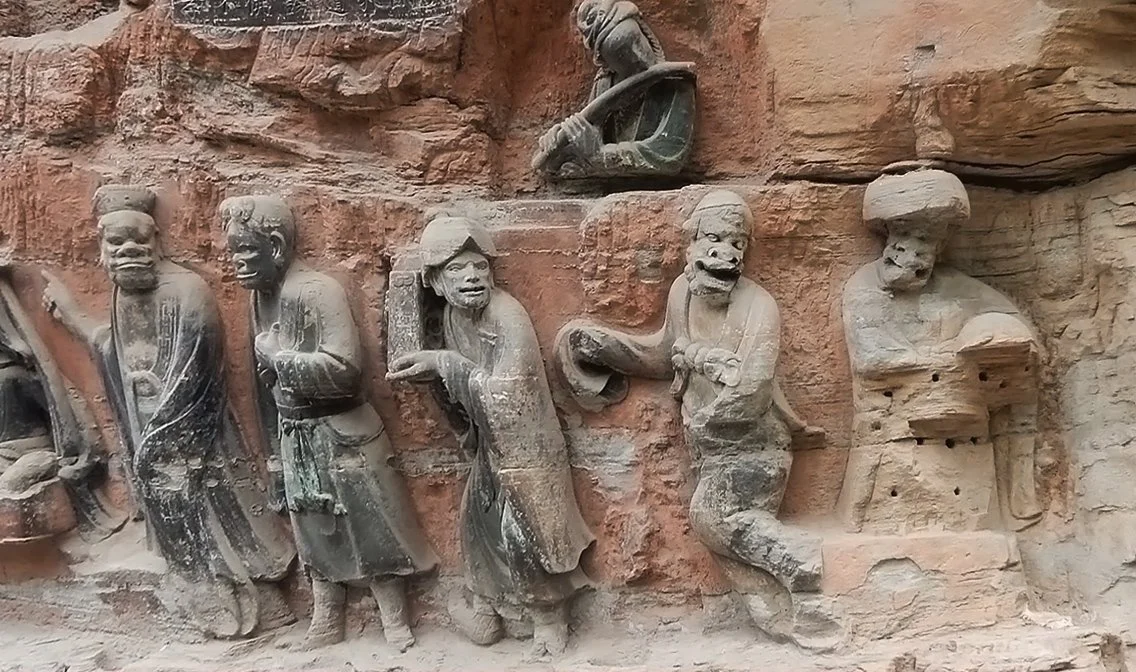
The materialist philosopher Ajita Kesakambali (fourth from left) depicted among the "Six Heretical Teachers" at the Buddhist Dazu Rock Carvings, China. This effigy highlights India's earliest recorded proponent of physicalism, who argued consciousness ends completely at death.
Then there was Ajivika, founded by Makkali Gosala around the 5th century BCE. Ajivika is an extreme form of fatalism or determinism. They believed in the complete absence of free will and called this idea Niyati. They believed that all things were preordained and did not believe in the idea of a theistic god, nor even in the idea of Brahma (absolute non-dual consciousness) in the Vedas, and they rejected the ideas of Karma and reincarnation. They believed that no human effort could change Niyati, and that the ethics of Karma was a wishful fallacy. Ajivika means “follower of the way of life” in Sanskrit, implying a deterministic model of reality. Many Ajivikas were known to renounce society and live in isolated communes, but many also lived regular lives. Their worldview also included a theory of atoms—they believed that reality was made up of a certain unseen, indivisible unit. They called it paramanu. Some scholars say that Ajivika ideas were present even before the time of Makkali Gosala. The Ajivika did believe in the concept of Atman, or soul, as in the Vedic texts, but it was believed that the Atman was structurally identical to the paramanu, or atom, and not separate from it. We do not know how the paramanu was described, or if it even was.

Later Jain and Buddhist art often demonize Makkali Gosala (right), depicting him physically attacking Mahavira (left). Early texts symbolize the “attack” as their philosophical disputes and Makkali’s criticisms aimed at Mahavira rather than a literal historical event as later Jain and Buddhist legends misinterpreted.
Agyana philosophy is thought to have originated around the same time as Ajivika, and it competed with Jain, Buddhist, and Ajivika ideas. Agyana comes from the Sanskrit “a-gyana,” which means “without knowledge.” This is thought to have been formalized after being inspired by skepticism and agnosticism about the metaphysics of the Vedas, as mentioned in the Rigvedic Upanishads, especially the Nasadiya Sukta (creation hymns). Here, Yagyavalkya questions and argues that ultimate reality (Brahma) and the atma (self/soul) are impossible to know. This paved the way for skeptical schools of thought to grow. Agyana philosophy is documented mostly in the works of the Jain scholar Silanka. According to Silanka, they believed that it was impossible to derive knowledge about metaphysical concepts such as Brahma, the soul, or the afterlife. They believed that even if such knowledge were theoretically possible, it would be pragmatically useless. Silanka writes that these skeptics would say, “Who knows that the soul exists? Of what use is this knowledge? Who knows that the soul does not exist? Of what use is this knowledge?” This was a criticism aimed at different schools of thought having inconsistent metaphysical ideas about the soul. Silanka describes the Agyana skeptics as not having their own ideas, but as having specialized only in pure skeptical thought processes. Their position was mostly strictly agnostic—they would not commit to a metaphysical position but would keep questioning any established position.
They also argued against omniscience and criticized the idea that the contemporary Buddha or Mahabir were omniscient, as claimed by their followers. They stated that because humans are limited by intellect and perception, they lack the epistemological tools to know whether a religious leader, such as Buddha, or an entity, such as god, is omniscient. They argued for the impossibility of absolute knowledge or truth due to the relativity of human perception. Because individuals experience reality differently, an objective and universally communicable truth cannot exist. By demonstrating through sound arguments that all metaphysical speculation ends in contradiction, they highlighted its futility. Pali texts also criticized the skeptics as “eel wrigglers,” saying they never stuck to a position and kept escaping with questions. Agyana was less of a philosophy and more of an approach.
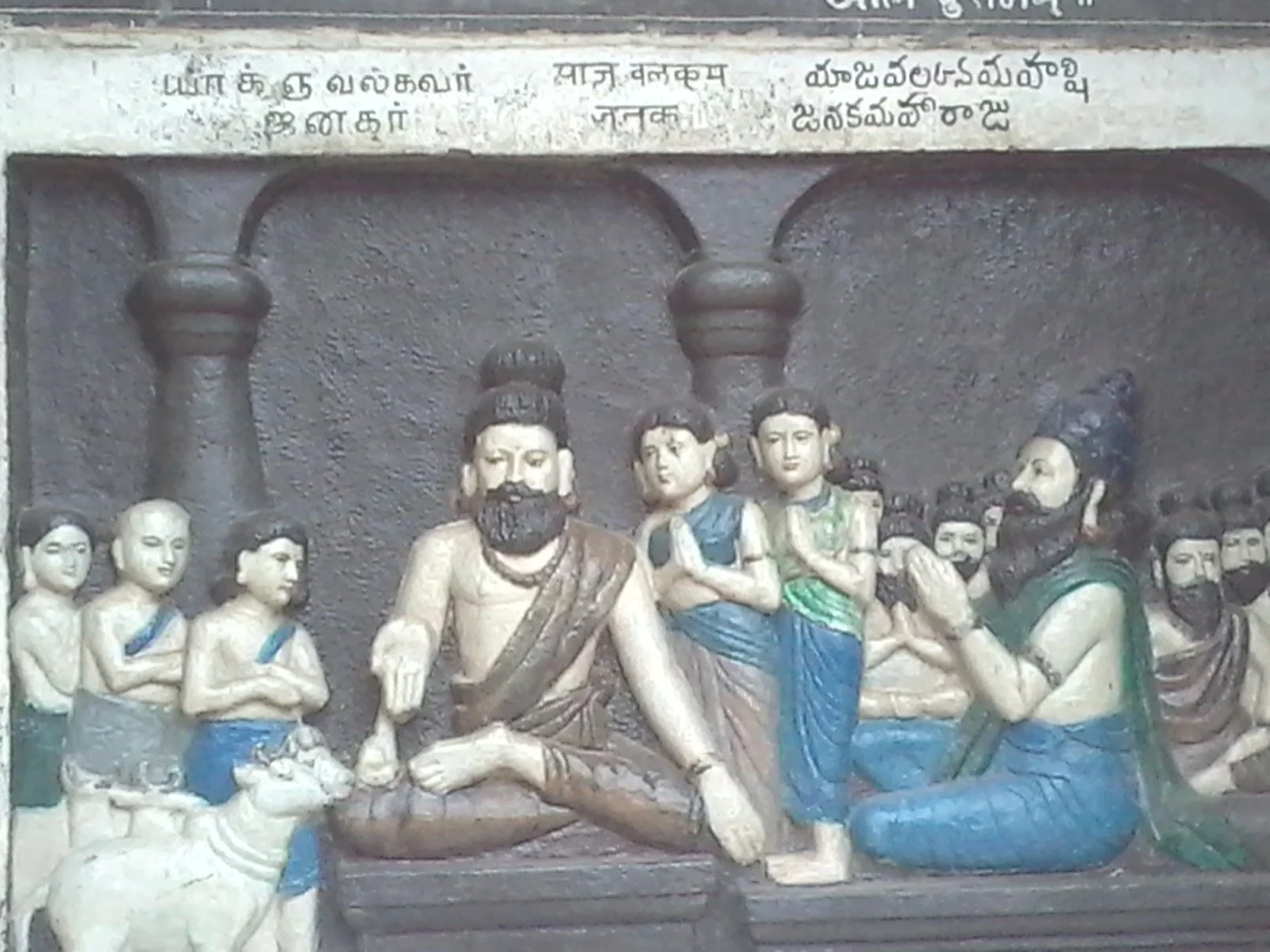
South Indian depiction of Yagyavalkya (center) teaching “Bramha vidya” to Janaka (Right) of Mideha (Philosopher King of ancient Mithila Kingdom in present day south eastern Nepal)
All these atheistic schools are described in secondary sources such as the Upanishads (later additions to the end of the Vedas), Buddhist Pali scriptures, and Jain literature, so we might not know the full extent of their origins except through critical lenses. This is because most of these secondary texts incorporate Charvaka, Ajivika, and Agyana ideas in order to refute or criticize them. Unfortunately, we have no way of knowing how far these ideas went, how they evolved over time, or how they influenced ancient Indian civilizations. Sometimes I wonder, what would have happened if these ideas were still mainstream? Would this part of the world be any different than what we know today? Maybe it would be or maybe it wouldn’t. But it is worth asking - of what use is this knowledge?
