

On Stoicism
Just like many people, when I first heard the word 'stoic', I looked it up, and many dictionaries showed me definitions that sounded somewhat similar to what Google gives you—a person who can endure pain or hardship without showing their feelings or complaining. The first character that came to my mind was my father. He happens to be this hardened, seasoned struggler, whom I've heard complaining on fewer occasions than the number of fingers on my hands. But sadly, I am nothing like him in any way, so I don't consider myself a stoic in that regard. I claim to be just the opposite, but this blog is not about me, nor does it deal with my father—but rather about a philosophy that has been adopted, knowingly or unknowingly, by countless mentally strong men and women throughout human history.
I was first introduced to the idea of Stoicism in a very non-traditional way. There was this time I was watching an episode of 'Gotham', a FOX and DC television series based on the early life of Bruce Wayne and Jim Gordon—a sort of prelude to DC's Batman comics. The series turned out to be very superficial towards the end of the second season, but for its early episodes, it was more or less captivating. So in this one episode, young Bruce meets his company's tech supervisor, Lucius Fox, to ask for clues about his father's murder. Fox then explains by revealing that his father, Mr. Wayne, was a stoic and would never make careless decisions. Rest aside, the word 'stoic' had caught my attention. I then looked it up and was subsequently directed towards the philosophy of Stoicism itself.
For a few years then, I started casually learning about Stoic philosophy from others who knew more about it. There were numerous articles on the core tenets of Stoicism in The Atlantic and Aeon. I also devoured the Stoicism page on Wikipedia as much as my memory could retain, watched numerous video essays dealing with similar ideas, and subscribed to and listened to numerous podcasts that dealt with this topic on a regular basis—the most notable one being 'The Daily Stoic' by Ryan Holiday. However, I came to read Marcus Aurelius's famous work on Stoicism, 'Meditations', fairly recently after being inspired by a very close friend of mine. It may seem as if I was obsessed, which is only partly true since I never seriously considered becoming a stoic myself. It's not as easy as declaring myself into a certain doctrine, and Stoicism, I have come to learn, is not just about garnering the identity of this line of thought but rather about practising it whenever you can. Don't get me wrong, I still don't consider myself a stoic, although it is one philosophy I have found to be practically useful for daily life—especially for acquiring useful insight for enduring the long and uncertain journey in my career.
When we first look into the philosophy, we may assume that it's a strategy for hiding our emotions. I'm guilty in this regard as well, but the more I looked into the philosophy, the more I discovered that it's not a very organized idea to be described in just one sentence. The word Stoic comes from the Greek word 'stoa', which simply translates to 'porch' in English. This is because the first Stoic philosophers in Greece, like Zeno, preached and dictated their philosophies to pupils from the porches of their schools. The word stuck after the Hellenistic period, much later than the time of Zeno, even though the tradition vanished into the vastness of history. The problem with this terminology is that not one philosopher we know as a Stoic today ever assumed that title for themselves in their teachings. For instance, Marcus Aurelius, the emperor towards the end of the old Roman Empire, wrote Meditations as a diary for objective self-reflection and to practise philosophy for just himself. He never really intended it to be spread through publications. Likewise, Zeno never really taught his pupils the philosophy of Stoicism; he just taught philosophy. Epictetus and the Roman Seneca never really mentioned the term Stoicism in their writings or teachings—they all just called themselves philosophers practising philosophy.
What we today identify as Stoicism is nothing but a set of practically useful philosophies that many men in history have come to agree or elaborate upon. Individual stoics have ranged from emperors like Marcus to slaves like Epictetus. They have been highly spiritual and pious, but they have also been skeptics who doubted the gods of their times. They span across different times, religions, and cultures, but the core tenets of their individual philosophies for approaching life remain strikingly similar. Ibn Sina (aka Avicenna) and Rhazes, for instance, were physicians and philosophers of the Islamic Golden Age with keen interest in Stoic philosophy. It could be said that some eastern philosophers like Lao Tzu, Confucius, Zen master Ikkyu Sojun, or even the Hindu economist Chanakya were in some ways Stoics, as many of their ideas on self-reflection and endurance resonated with those of the classical Stoics from the West. What's even more interesting to note is that the reiterating themes of endurance and composure in the Stoic philosophies could be said to have been simple empirical observations of this diverse group of people, pertinent to their time of existence.
Even some well-known critics of Stoicism, like Friedrich Nietzsche, have inadvertently adopted some aspects of Stoic philosophy for themselves. It can be said that Nietzsche's critique of Stoicism was borne out of an obvious lack of understanding; perhaps he assumed Stoic philosophy to be a singular conformist attitude in favour of the Judeo-Christian way of life he was so critical of. Perhaps he thought Stoicism was just about wearing a mask in public to suppress our emotions. But regardless, his ideas of Amor Fati (the love of one's fate) and the purpose of his thought experiment of Eternal Recurrence are intimately tied, albeit unknowingly, to the core tenets of the Stoic way of life. Why this has happened is probably because Stoicism encompasses a set of observations made by people for the sole purpose of introspection, selective indifference, coping, and endurance—skills that are very useful and needed by all of us, regardless of gender, culture, race, or era. And since human nature is too obviously universal, our philosophies in this way do tend to resonate across millennia.
Although many people can get their insights from other means such as Zen Buddhism, Sufi mysticism, or even Hindu Vedic philosophies, most of us make the mistake of immediately identifying with the name of the first idea we come across. For example, we tend to readily identify as a 'Buddhist', even if Buddha himself may never have intended the same for himself or his disciples. This approach, I think, is quite hasty, and similarly, it may also be wrong to call ourselves 'Stoics' just because we like many aspects of this philosophy. However, what has drawn me towards Stoicism is its immensely useful practicality rooted in the basic rules of human nature. In short, Stoicism is perhaps one line of thought that never really goes against human psychology, all the while being a useful tool for improving it. It teaches us to see ourselves and other humans as phenomena, like how we observe rocks or other animals. One recurring idea in Stoicism is to not complain about the rain—not because we shouldn't, but because we should identify the futility of the complaint, as we cannot do anything about it.
Marcus Aurelius specifically found it useful to read people, and he did that by seeing them as facts of nature, even through their emotional outbursts—all so he could deal with people in the way they wanted and could also empathize with them or avoid them when needed. Stoic ideas have less to do with suppressing our emotions than with acknowledging them, so in the end, we become less affected by our own as well as those of others. Common sense. In this way, Stoic philosophers have talked about many different areas concerning human life, from relationships with others and proper use of power to perseverance and curiosity. Contrary to the popular criticism that Stoicism makes us suppress our feelings and emotions, it instead encourages us to channel them safely to where they're worth it, thus removing the need for us to suppress our emotions in the first place. Obviously, my take on Stoicism is limited in this particular article. Perhaps I'll talk more about the details of Stoic philosophy in a later sequel to this blog, but I can't stress enough how important the findings of Stoic philosophers can prove to be for us all.
A topic for a later day: I'm also intrigued by how Stoic ideas have been supported in many ways by the current findings of present-day cognitive and evolutionary psychology. For example, an empirical psychological therapy known as Cognitive Behavioural Therapy, or CBT (a kind of psychotherapy), has proven to be effective for addressing numerous mental conditions and personality disorders in the clinic. CBT teaches us to envision ourselves objectively, to reflect on our past actions, and to see our emotions in action—exactly how we are affected by other people and how we react to them. It gives us insight to improve upon our mental resilience—much like the core ideas in Marcus Aurelius's Meditations and the rest of Stoicism. Perhaps this is how Nelson Mandela, who was a self-admitted follower of Marcus's notes, endured his stressful 27 years in prison. And much like him, I think it is about time we all gave Stoic ideas a try, even if we can do that just once.
Also a topic for another day: Stoic principles have been mislead and wrongly communicated by some influencers and podcasters in the “manosphere”. These people cherry-pick stoic values to suit their ulterior motive which is to gain followers and to profit off of them. For example they would glorify and romanticize hardwork, and endurance (especially and usually only for physical strength and workout) but completely disregard the value of duty and responsibility towards fellow human being (including women and gender minorities). Theirs is not stoicism, it is something rather sinister.
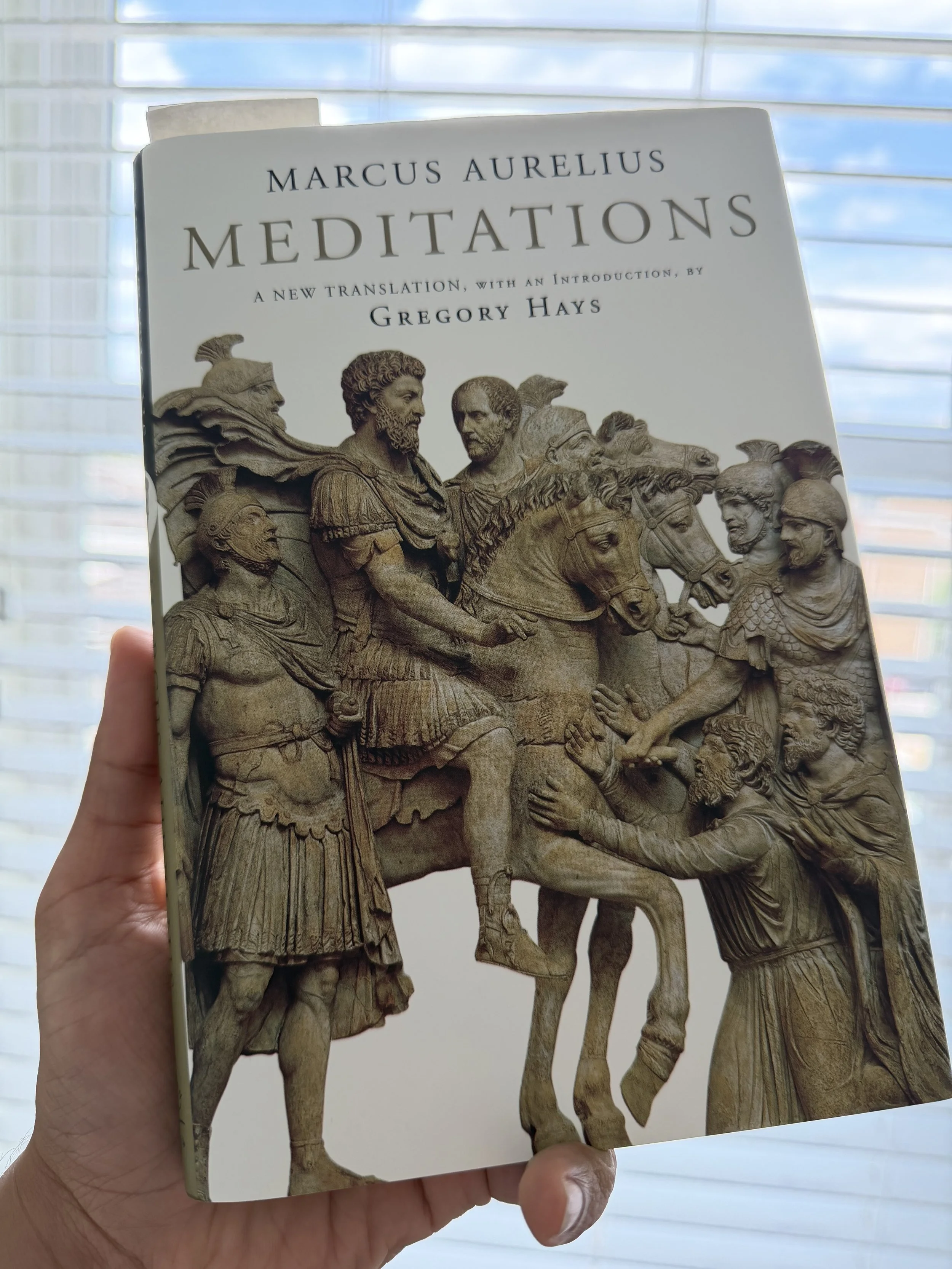
Best translation and my personal copy, annotated and all…..
