Non-thought
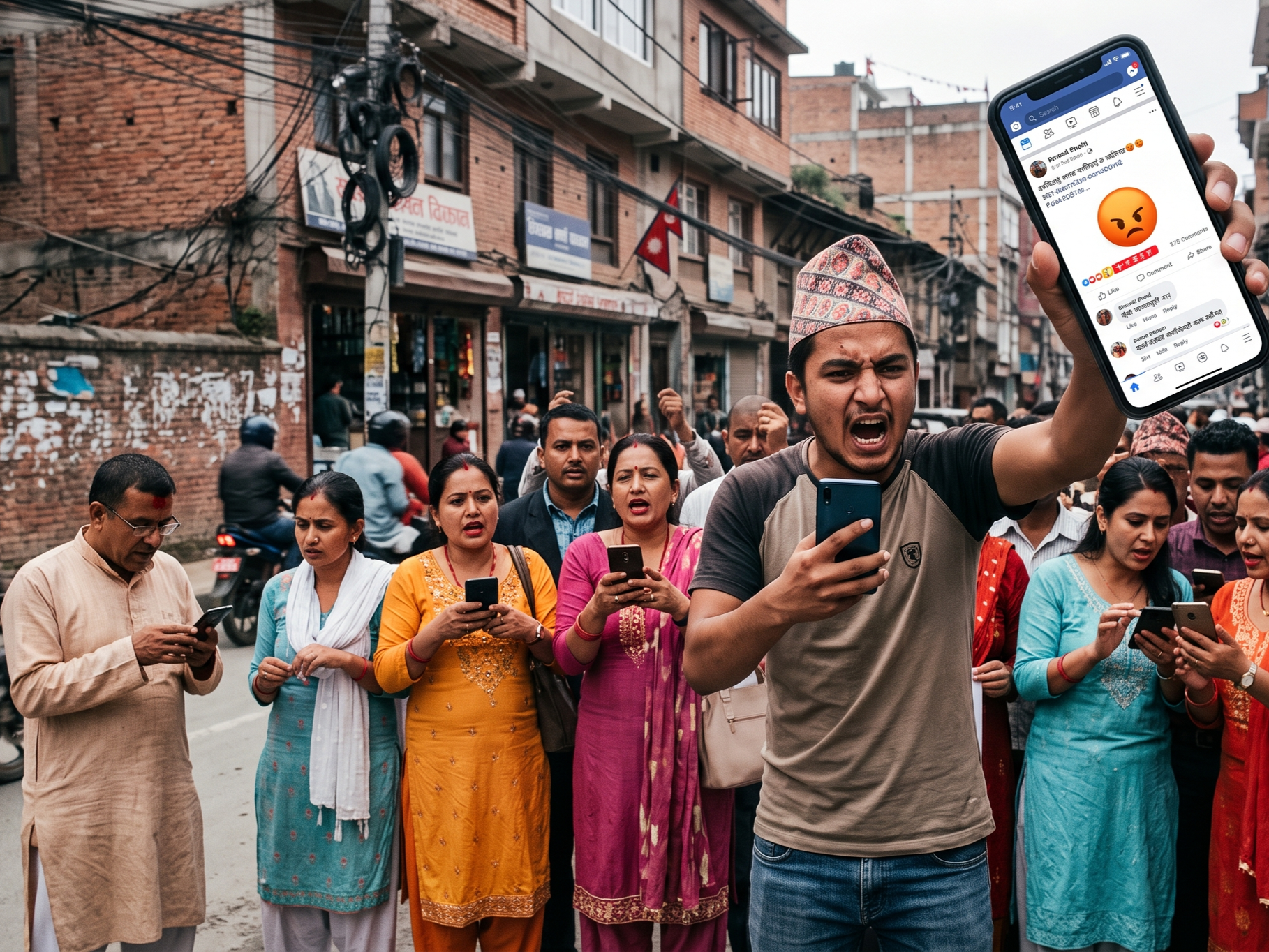
Here are examples of some recent opinions or comments on social media, some of which I encountered personally on my social media posts and some of which I encountered while scrolling:
"You shouldn't criticize the prime minister because he has good intentions and wants to develop Nepal." — "You shouldn't criticize the prime minister because you need to give him a chance."
"The guy just passed away. Have some respect. We should not question his intentions and should not take allegations of sexual misconduct seriously." — "This guy is such a big sportsman, why would he jeopardize his career by doing such a thing? He would know better."
"You shouldn't criticize Gurus, and you shouldn't disrespect religion by saying you need to question Gurus."
"You shouldn't disrespect religious beliefs and spread toxicity against Sanatana Dharma, which was passed down across generations, by saying religious beliefs require blind faith."
"The Brahman is the absolute truth and pure consciousness because the very ancient Vedas and Upanishads have documented them."
"Critical thinking is a negative way of thinking and is not beneficial for everyone and is a 'Western' way of thinking not suitable for us in the 'East.'"
"Religions are always good. People are bad."
"The Hanuman Chalisa accurately calculated the distance between the Earth and the Sun."
These are common criticisms and opinions many cultural critics may face in Nepal while questioning mainstream and popular opinions. They are all quick to confidently moralize and assert something, without realizing why they are even doing so. Remarks like the ones above may seem like they are "good" and "non-obstructive" at first glance to anyone who is not suspecting, and perhaps even as "common sense" to some, but when you think about these issues deeply and from different angles, you will be compelled to question such statements - are they even valid? Of course, everyone has the "right" to have opinions in a democratic society, and that is why we see so many uncritical podcasts on the internet these days freely talking about all sorts of things. But does the "right" to share opinions mean that you "ought" to share one? Occasionally I tend to think that if we haven't thought about a topic deeply enough from different angles, we should just shut the fuck up for the greater good. This would add less noise to the already noisy public sphere. But of course, that is also my opinion. I don't intend to silence people; it's merely just a recommendation. The point is to at least try to have a more nuanced opinion than a superficial one -- especially on sensitive and grave topics. And despite having a nuanced opinion, say you are wrong (humans often are wrong), you need to have the intellectual honesty to disclose it and admit that you were wrong, then the next step would be to correct or update your opinions. It's okay to be wrong but at least be honest about it and at least be aware of your own fallibility. I personally call such haphazard opinions "non-thought" -- I am sorry, you have not thought through whatever you just blurted out. Unfortunately, we currently live in an age of "non-thought".
Much of what I call non-thought runs on emotional heuristics and the need to protect one's identity. As the psychologists Daniel Kahneman and Amos Tversky described them, heuristics are mental shortcuts the human brain takes to reach a certain conclusion about real-world events or phenomena. These are quick, require low effort, and seem like "common sense" because they have an intuitive evolutionary survival advantage. We have been wired and tuned by nature to use heuristics for our survival - if the bush is moving in the dark, it could be a predator that could harm us, so we run or fight. On the off chance that the rustling was to be an actual predator - quick thinking may help us survive. But in modern society, such chances are often unrealistic. The bush is probably rustling due to anything other than a predator. And in modern society, issues are often complex and layered, demanding our time and effort to try to understand them. For this reason, heuristics do not always work and are not enough for understanding concepts or facts. Non-thought arises because the ego (by "ego" I mean self-referential thinking) falsely registers a challenge to one's opinions as a challenge to one's survival, and this triggers quick thinking - to attack, or oppose, or opine without any further thought. You also need slow, uncomfortable, and effortful thinking for better knowledge and better understanding.
If you want to understand the basics of how vaccines work, for example, you will need to understand (not just memorize) at least the basic concepts of human physiology, immune system, herd immunity, public health, pharmacology, controlled trials, research types, and economics. For this, you would require the slower, more careful thinking and must try to look up scientific literature and expert consensus -- which can be very challenging to read and rightly so because they are dealing with complex issues. Quick thinking-based opinions derived from a certain podcast or a certain 30-second-long engaging video about vaccines will not help you understand the principles of vaccines and immunity. A random layperson mom with no such understanding or a wrong understanding of vaccines - going on a random podcast to spread fear regarding vaccines -- how much is that justified and honest? Does she understand the consequences of her non-thinking? How many lives is she harming?
Slow thinking takes effort, is energy-intensive, and time-consuming. Quick thinking is intuitive, effortless, and appeals to our emotions readily, and thus we are more likely to believe conclusions drawn through this than the former. Slow thinking requires training or practice; fast thinking is easy and intuitive. Slow thinking is uncomfortable and may help you understand why you could be wrong, but quick thinking usually makes you assume you are right - often with conviction - even when wrong. It's only when you are good at slow thinking that your fast thinking improves in parallel. You can't abandon slow thinking for fast thinking is what I am trying to say because both are inescapable parts of our cognition.
So, the point is that the example phrases above are not well-thought opinions or positions at all. And interestingly, they belong to engineers, doctors, nurses, computer scientists, and lawyers -- all probably competent in their fields - but I think these opinions are quite immature, not just because they do not align with my opinions, but because they are conclusions reached before the questions were asked. These are opinions or positions formed because of taking someone's (or social media algorithm-driven) assumptions or information at face value without even making the slightest effort in questioning them and without trying to understand the complicated layered ground realities beneath them. This is to show that even intelligent people fall victim to fast thinking. Your degree doesn't say how well you can think critically. The owners of these opinions have clearly not questioned their thoughts as I think they should. Maybe it should have been done in the following ways:
"Why can people not question the prime minister? Is it not reasonable to hold democratically elected officials accountable for their ideas and actions? Will the intention to do good always do good?"
"Does the death of a celebrity with tremendous achievements absolve them of their misconducts? Are allegations by multiple independent and unrelated victims not to be considered at all unless proven in court? Do incredible achievements excuse bad behavior? Do we have to worship personalities just because of their incredible achievements? Just because someone did something extraordinary, does it mean we need to dismiss or unsee their dark side?"
"If we cannot question gurus, how would we learn about their errors? Are we considering gurus as super-humans? If they are humans, they might be wrong, and if we don't question their ideas, would I not risk taking their assumptions and misunderstandings as actual evidence or understanding?"
"If 'Sanatana Vedic dharma' were oral traditions that were passed down through memories and dictations, would some things not be mistranslated or misremembered? Are memories perfect? Why should we consider their possibly unreliable notions as truths?"
"Where did the scriptures come from in the first place? If the idea of Brahman being the "absolute truth" or "pure consciousness" came from the Vedas and Upanishads - who wrote them and how did they know? Can they not be wrong? Even if someone wrote them, what reasons do we have to believe that they are not making assumptions? If they are not assuming but are knowing that there is such a thing as "absolute truth" why is subjective means the only way to know them when the same people also understand that subjective truths can be misleading?"
"If critical thinking is a "western" way of thinking why did eastern cultures have Sramana and Heterodox movements in the form of Charvaka, Ajivika, Ajnana, Buddhism and Jainism that moved away from Vedic philosophy many centuries before western enlightenment? If critical thinking is not beneficial and is a negative way of thinking, why do people use it while shopping for vegetables or a used car? Why do they not believe the seller right away and pay per their initial ask?"
"If religions are always good, why would there be wars based on interpretations of scriptures? If scriptures can be interpreted in any way by anyone, would that not form shaky grounds for morality and ethics? If people are bad and religions are always good, why do less religious or non-religious countries score higher on health, educational, and well-being indices compared to very religious ones? And if the answer is that wealth explains both, does that not itself undercut the claim that religion is what makes a society good? Why do secular altruistic organizations exist at all?"
"Was it really the Hanuman Chalisa that calculated the astronomical unit, or is that a modern reading imposed on a devotional verse? What calculation or equation is given, or is it a vaguely worded line? Who wrote it, and when? Was a yojana ever a fixed length, or were the values retrofitted until the number came out right? Was it as accurate or as ancient as stated?"
Finding out answers to these questions takes time and effort. Once you consider finding out and then look at these issues from various angles, you will begin to realize that the real answers will be somewhat different than what you initially set out to assume. You will be glad that you didn't blurt that opinion out or write that post or make that video after taking a step back to educate yourself. Intellectual honesty starts from asking the right questions, challenging your own ideas about a certain topic, then settling for the best possible explanation - not just any explanation.
But my major concern is in realizing that in an age of TikTok gurus and billionaire Twitter scientists, will people even find my article relevant? Will people even read this? Whatever, the most basic thing we can honestly do is to think, then react, not the other way around. As per Alberto Brandolini's law (the bullshit asymmetry principle), it really is easy to come up with bullshit, but energy-intensive and time consuming to debunk bullshit.