

Garud Puran, distance from earth to sun, and meditation
I recently came across a TikTok video in which a prominent physician in Nepal, on a popular talk show with a well-known reporter, casually claims that Sanatani/Hindu philosophy is, in his opinion, way ahead of its time. He claims that the “Garud Puran” has accurately calculated and predicted the distance from the Earth to the Sun. He goes on to say that these ancient philosophical ideas are validated by modern neuroscientific principles. The example he gives is the claim that studies have shown that monks who meditate can smoothen and flatten their brain waves as if they were asleep and in a state of “super-consciousness” — his words. The reporter then adds that these meditating monks can slow time, slow their respiratory rates and physically levitate their bodies, which the physician agrees with and confirms as true. It is also claimed that eastern philosophy and metaphysics matter, that people in South Asia understand them better, and that some understand both modern science and Sanatan metaphysics — implied to be vaguely beneficial.
Lots of very big claims. And coming from a physician — someone who claims to understand both scripture and science — surely they must be true. Let’s explore.
Claim 1: The Garud Puran predicted the Earth-to-Sun distance
First, we need to understand what the Garud Puran is. It is a mythological scripture, customarily read on the 3rd or 4th day of kiriya-pratha — a ceremony held after someone’s death to commemorate them and help their soul reach Yamalok. Yamalok is the realm of Yama, the Sanatani god of death and justice — a realm similar to Helheim (or Hel) in Norse mythology and Hades’ underworld in Greek mythology. According to the Garud Puran, the soul must cross the river Vaitarani (pronounced Baitarani in Nepali) to reach Yamalok, much as souls in Greek mythology must cross the river Styx to reach the underworld.
Within the Garud Puran, the second section — known as the Preta Kalpa or Preta Khanda — is dedicated to death rites and the afterlife. Depending on the translation, it is usually chapter 33, verse 3 that mentions any measurement of distance. There, Lord Vishnu tells Garuda (a half-human, half-vulture demigod): “The intervening route between the human realm and Yama’s world extends, by measure, eighty-six thousand yojanas.” In the Garud Purana Saroddhara, a summarized version of the original, the same idea appears in chapter 2, “An Account of the Way of Yama,” as “the way of Yama is eighty-six thousand yojanas long without Vaitarani.” This version also mentions that a soul travels exactly 247 yojanas per day to reach Yamalok. 86,000 divided by 247 gives 348 days — which is why the Garud Puran originally recommended almost a year of kiriya-pratha, with daily recitals: the idea was to wait the 348 days until the dead person’s soul reached Yamalok. Regional scholars later reduced this to 13 weeks and eventually to 13 days, for the pragmatic reason that human life got busier and a year-long kiriya-pratha became impractical.

Nowhere does the Garud Puran mention any distance between the Earth and the Sun. So the claimant got a basic fact about Sanatani/Hindu scripture wrong. The text that does mention this distance is the Hanuman Chalisa — a very modern scripture by comparison, and one written not in classical Sanskrit but in Awadhi. Just as the Romance languages grew out of everyday “vulgar” Latin rather than the classical form, Awadhi descends from the Prakrit and Apabhramsha vernaculars rather than directly from classical Sanskrit — and it is still spoken today in northern India and parts of western Nepal.
For context: the river Styx in Greek mythology originated in oral tradition somewhere around 1600–1100 BCE (Before Common Era), with formalized texts first appearing around 800–600 BCE. The Manu Smriti was compiled over a long stretch, commonly dated to between roughly 200 BCE and 300 CE or common era (or 2nd–3rd century CE). Norse mythology grew out of older Germanic oral tradition, with its surviving texts — Poetic and Prose — compiled around 1200–1300 CE. By comparison, the Garud Puran took shape over the first millennium CE, with the version we have usually dated to around the 9th–10th century CE. The Hanuman Chalisa is very modern by any standard: this long-form poem — a bhakti ode to Hanuman — is traditionally attributed to Goswami Tulsidas (1511–1623 CE, the same author credited with the famous Tulsidas Ramayan), placing it in the late 16th century, roughly Bikram Sambat 1633 to 1657.
Let’s give the claimant the benefit of the doubt — assume they simply mixed up their sources — and look at exactly where and how the Hanuman Chalisa describes the Earth-to-Sun distance. It is in the verse “Yuga sahasra yojana par Bhanu, leelyo tahi Madhura phala janu,” which in Awadhi translates roughly to: “The Sun is at a distance of thousands of yugas and yojanas; you swallowed it, thinking it to be a sweet fruit.”

But modern internet apologists have retrofitted the numbers in some interesting ways. They claim a Yug equals 12,000 years based on Vedic cosmic cycles; that sahasra means exactly 1,000 (akin to how “kilo,” from Greek, indicates 1,000); and that a yojana is a traditional measure of distance equal to roughly 8 miles, or 12.8 kilometers. They then multiply: 12,000 × 1,000 × 12.8 = 153.6 million kilometers. The mean distance between the Earth and the Sun — one astronomical unit — is about 149.6 million km. Very close. To be more precise, it is defined as exactly 149,597,870.7 km. (Strictly, the astronomical unit is now a fixed, internationally agreed constant rather than a freshly measured value, and the real Earth–Sun distance varies between roughly 147.1 and 152.1 million km over the year, because Earth’s orbit is an ellipse.) Taking the retrofitted Hanuman Chalisa figure at face value, 153.6 minus 149.6 leaves about 4 — so the calculation is off by roughly 4 million kilometers, which is a lot. That gap is about 314 Earths lined up side-by-side. A spacecraft aimed at the Sun using the Hanuman Chalisa verse would never reach it.
And that 4-million-km miss is the charitable reading — it assumes the retrofit is a legitimate calculation in the first place. It is not, and that is the deeper problem. When you compute a distance through addition or multiplication, every quantity you combine has to be a unit of distance. A yug (or yuga) is not: it is a unit of time — a cosmic cycle or epoch. Under the Vedic framework (specifically the Vedanga Jyotisha), a yug is exactly 5 years long. The figure of 12,000 came much later, in the Manu Smriti, where it was defined as a “year of the gods” — a sahasra of 12 months in a calendar year (1,000 × 12) — because the gods were thought to live far longer than humans. Other texts and translations derive 12,000 instead from the sum of the four yugas: 4,800 years of Satya Yuga, 3,600 of Treta Yuga, 2,400 of Dvapara Yuga and 1,200 of Kali Yuga, which totals 12,000. The point is that it makes no sense to multiply a time, a count and a distance and call the result a distance. On top of that, the scriptures themselves do not agree on how long a yug is. Some modern texts add more zeros (not 12,000 but 12,00,000), which would put the Earth-to-Sun distance at 15.3 BILLION km — off by an absurd margin, though we would be frozen out of existence long before any spacecraft confirmed it. Go instead by the oldest Vedic texts, where a yug is 5 calendar years for repeating rites, and the same method yields an Earth-to-Sun distance of 64,000 km. That is like flying from New York to Sydney four times. If the Sun were that close, we would be barbecued out of existence.
So, the physician — or anyone who claims the Garud Puran predicts the Earth-to-Sun distance — is wrong, because anything close to it was described much later, in the Hanuman Chalisa, in Awadhi rather than Sanskrit. And they are wrong not just by modern scientific standards but by the internal logic of the Sanatana scriptures themselves. There is no need to invoke modern science, or any East-versus-West dichotomy: the claim is simply built on premises that misstate basic historical facts about the very scriptures it leans on. What can we call this if not wishful thinking? We can make anything up. It is interesting to play with, but to assert it as fact or truth is dishonesty, if not ignorance.
Claim 2: Meditating monks can flatten their brain waves to mimic sleep or “super-consciousness,” and can slow time, breathing and the need for food
This one interested me more, because I study brain waves for a living — they will be my bread and butter for probably the rest of my professional life. “Brain waves” are technically electroencephalograms (EEG), physiologically and electrically analogous to our “heart waves,” or electrocardiograms (ECG).
A 2004 study by Dr. Richard Davidson and his team at the University of Wisconsin looked at Tibetan Buddhist monks — practitioners from the Nyingma and Kagyu lineages — who had logged somewhere between 10,000 and 50,000 hours of meditation. It did not show that these monks’ brain waves were “flat” or “smooth,” as the claimant stated. It showed the opposite: fast alpha and theta activity, plus high-voltage (decidedly not flat) gamma activity. The researchers used high-density EEG electrode arrays — denser than a standard clinical EEG net — to record the monks. The monks were asked to generate a state of “non-referential” or unconditional compassion, without focusing on any specific object or image. Normal restful, awake EEG activity sits in the alpha range (about 8–12 cycles per second), mixed with some beta activity (about 12–25 cycles per second); sleep slows this into the theta (4–7 cycles per second) and delta (0.5–3 cycles per second) ranges. The monks instead showed increases into the gamma range (>25 cycles per second; the study focused on the 25–42 Hz band), along with alpha and theta. The non-monk controls — ordinary people — showed only the expected alpha-theta activity.
But this study involved just 8 monks. Eight is a tiny number to generalize from: with a sample this small, a striking result can reflect the quirks of these particular individuals rather than meditation itself, and it cannot tell us how common the effect would be in the wider population. To be fair, the design compared each monk against his own pre-meditation baseline rather than relying only on the monk-versus-control contrast, which softens the concern somewhat — but small samples still swing around easily. The whistle-and-coin example captures the worry: if you flip a coin 8 times while whistling and get 6 heads, then 8 times without whistling and get 2, the gap does not show that whistling causes heads. Short runs scatter like that on their own.
The other problem is recording the gamma wave itself. No matter how densely you place leads on the scalp, picking up gamma activity (>25 cycles per second, or Hertz) from the surface is hard — not because the recorder cannot keep up (modern EEG samples far faster than gamma requires), but because true gamma is low in amplitude (height) and easily swamped by electrical activity from the small muscles of the head and face. This muscle artifact (EMG) lives in the same high-frequency range, so a lot of what looks like gamma can actually be muscle noise rather than brain activity. It is like trying to hear a whisper while someone keeps clearing their throat next to the microphone. To their credit, the Davidson team used a referencing montage specifically designed to stop muscle artifact at one electrode from leaking into its neighbours — which is exactly the right thing to worry about. Even so, separating genuine low-amplitude brain gamma from contamination is the real challenge.
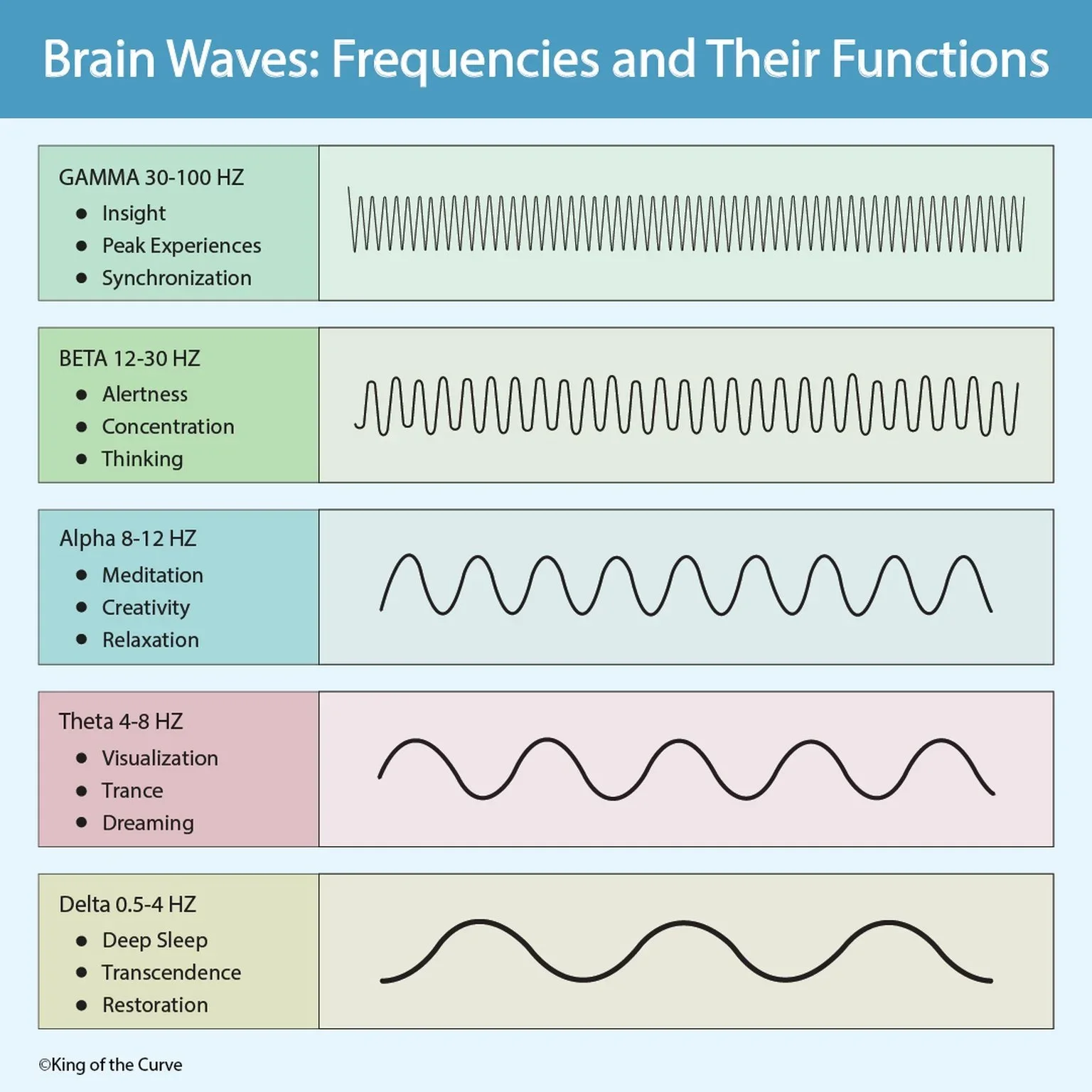
The study also carried confounders such as diet, and the controls were not monks but college students with drastically different lifestyles, stress levels and daily disciplines. Had those been controlled, the experiment would have more merit — but even then the hypothesis is shaky. What does “objective, unconditional compassion” even mean? What is “unconditional,” and how can we guarantee that compassion means the same thing to each of the 8 monks? How do you hold that constant? It is an unstable foundation to begin with. And finally, correlation is not causation. Still, the attempt was commendable, and it laid groundwork for serious research into mindfulness meditation. What is certain is that the monks’ EEGs were not “flat” or “smooth” — we only see that in people who are dead or heavily sedated with anaesthesia in the ICU, and I report such EEGs regularly as part of my job and training. And no study has ever defined or demonstrated what “super-consciousness” actually is, or how meditation would produce it. If the claim simply means heightened awareness and focus, it makes a little more sense.
Other studies have used better methodology, and their results are more worthwhile. Sara Lazar and her team at Harvard (2005, with follow-up work around 2011) used magnetic resonance imaging (MRI) to measure the thickness of the cortex — the brain’s outer layer — comparing 20 meditators to 15 non-meditators. They found that meditators had a thicker cortex, but they could not rule out the reverse relationship: that people with a naturally thicker cortex find meditation easier and so are more likely to keep it up. To improve on this, the Lazar group (Hölzel et al. 2011) ran a follow-up: they recruited novices, put them through an 8-week mindfulness-based stress reduction program, and compared their MRI results against a waitlist group who did not take the program. (This is a methodological weakness — they should have used a comparable “sham” activity rather than a passive waitlist as the control.) They found subtle increases in gray-matter density in several regions: the hippocampus, posterior cingulate, temporo-parietal junction and cerebellum. A separate study from the same group (Hölzel et al. 2010) found that reductions in perceived stress after the program correlated with decreased gray-matter density in the amygdala — the brain’s fear centre. Interesting results, but the methods still were not airtight, and the samples were too small for definitive conclusions.
A similar study came from Judson Brewer and colleagues at Yale in 2011, using functional MRI (fMRI). An fMRI maps blood flow in the brain in response to cognitive tasks — think of it as a video where a standard MRI is a photograph. The study was again small, comparing 12 experienced meditators with 12 matched controls — 24 people in total, too few to be sure the findings are real — and it found that meditation deactivated the default mode network (DMN). The DMN is a network running along the midline and base of the brain, connecting several key structures, that becomes more active when we daydream, dwell on the past, worry about the future, or think about ourselves in the first person — “I/me/my.” If you are daydreaming in class, your DMN is active; when the teacher calls on you and your focus snaps back to the board, the DMN quiets down. Focus is the key: any task demanding concentration tends to suppress the DMN. Meditation, which by its nature requires concentrating on an object, idea or process, probably suppresses it too — but we do not know how different that is from any other focused, concentration-heavy task. Brewer’s team also reported better executive functioning in meditators, and connectivity patterns that could correlate with stronger impulse control. Those secondary findings were not robust, though: with a sample this small, similar results could arise by chance alone.
The only conclusion these studies really support is that meditation seems to help the brain focus and concentrate — though we do not know whether the effect is sustained. And that much we could have guessed from common sense, without fMRI or EEG. What the studies do not tell us is whether people’s biology, personality, life experiences, individual brain networks and neural plasticity (the brain’s ability to rewire and adapt) make meditation easier to sustain for some than for others. Some people find meditation helpful; others do not, even after following every scripturally and culturally recommended practice meant to support it. So recommending meditation as a universal solution is premature and, frankly, dishonest. It may be harmless in the direct sense — but consider recommending meditation instead of medication to someone with severe, genetically driven depression. The moral responsibility for steering them away from proven treatment then sits with you.

I think we should study meditation more. I am keenly interested in practicing Vipassana myself. Trying it on my own, I did notice an improvement in my ability to focus, and I was distracted less when I kept it up consistently for a week. But a busy schedule and other responsibilities meant I could not maintain it. My positive experience may not translate to everyone, so I would be cautious about recommending it as a universally beneficial strategy.
Now, back to the claim about meditation slowing the breath. This is probably the most factual statement in the whole video. Multiple studies since the 1970s (Wallace & Benson 1971, Bernardi et al. 2001, and the 2013 American Heart Association statement) have shown that deep, sustained slow breathing triggers the vagus nerve — part of the autonomic parasympathetic (“housekeeping”) nervous system — which over time lowers baseline heart rate, blood pressure and respiration rate. The more you practise, the stronger the effect, so advanced practitioners can drop their heart rate and breathing to fascinatingly low levels. But so can advanced swimmers and runners, because their training engages the same parasympathetic system. I have seen professional athletes with resting heart rates around 50 startle some ancillary clinic staff — yet that is simply their normal. So meditation can do what the claimants said, but it is not unique to meditation, and there are other routes to the same destination. There are also several types of meditation that reach the same goal — transcendental, mindfulness-based, or pranayama (yogic breathing).
Meditation can slow the perception of time, but not time itself. Psychological studies of subjective experience in meditation have consistently found that participants report a sense of time dilation after a session, even though external clock time runs on unchanged. As for reducing the need for food, that is partly true, but the claimant likely exaggerates it considerably.
The remaining claim — physically levitating the body — is baseless and exaggerated. Most monks who have claimed to lift themselves off the ground through meditation have been exposed as frauds, using slick trickery of the sort stage magicians rely on. Numerous high-speed photography tests have debunked such claims. There are well over a hundred magician’s tricks for making a body appear to float; you would be surprised what human ingenuity can pull off. The incentive is usually to gain more followers, believers or donors. Monks and sages are people too, and they have vested interests of their own.
Conclusion
So what did we learn? It is very easy to make absurd claims — yet look at how much work it took just to get to the bottom of these few. Don’t feel bad about that asymmetry; I happen to be a weird guy who enjoys the mental exercise. Picking apart claims I’m skeptical of is, for me, a way of thinking better. It is also why this blog is called Sandehakari — doubt first, then find out. I approached these claims by giving the people making them the benefit of the doubt rather than dismissing them outright. Then I examined the claims on their own terms, looked up the sources they pointed to (here, the Sanatan/Hindu scriptures), and checked whether their logic held and whether they contradicted their own stated knowledge. The facts turned out to be wrong: the source was not an ancient scripture at all, but a comparatively modern poem that describes — but never calculates — any specific distance. I then checked whether anyone has actually demonstrated the extraordinary claims. Through that examination, out of everything asserted in that short video, only one claim held up. I was disappointed not to find any accurate measurement of the astronomical unit in the Garud Puran or other scriptures, nor any of the exciting promises made about meditation. This is why critical thinking matters. We need to screen for gaps in logic and focus on the actual concept being presented — to test whether the premises hold, and whether the conclusion really follows from them. Do not believe something simply because an authority asserts it (in this case the physician). Ask how they arrived at the claim; ask them to explain or demonstrate it; and watch how strong or weak that process turns out to be. Question everything and get comfortable being uncomfortable about your own claims – then correct and improve if you are wrong. It’s an honest approach to knowledge and understanding.
